
A Modern Pantheon

C.G. Jung observed that the pagan gods never disappeared after Christianity apparently erased them; they simply assumed a different guise, returning as diseases. According to the ancient myths, the gods take brutal revenge when mortals neglect them. Although Christianity suppressed pagan religion, the gods proved they are real and demanded our respect by reappearing in pathological form. Dionysos became the devil, Aphrodite sexual problems, and so on. The gods express human instincts. No matter what theology we believe in, those instincts always live within us.
I don’t think Jung has the full picture. In order to honor our human instincts, we don’t have to worship the Greek and Roman gods. We express them in a form more appropriate to the modern world, namely, as abstract ideas. Think how reverently we talk about family, home, culture, freedom... These are our gods today. Thus, we can construct a modern pantheon parallel to the ancient pantheon (see Table 1). If we look at our instincts this way, we can see that our relationship to them isn’t entirely pathological. Indeed, we often honor our instincts in a healthy way, and they in turn enrich our lives. This juxtaposition of ancient and modern pantheons yields new perspectives that can help us overcome the remaining pathologies of modern life. Here I want to make two major points.
Table 1. Ancient and Modern Pantheons
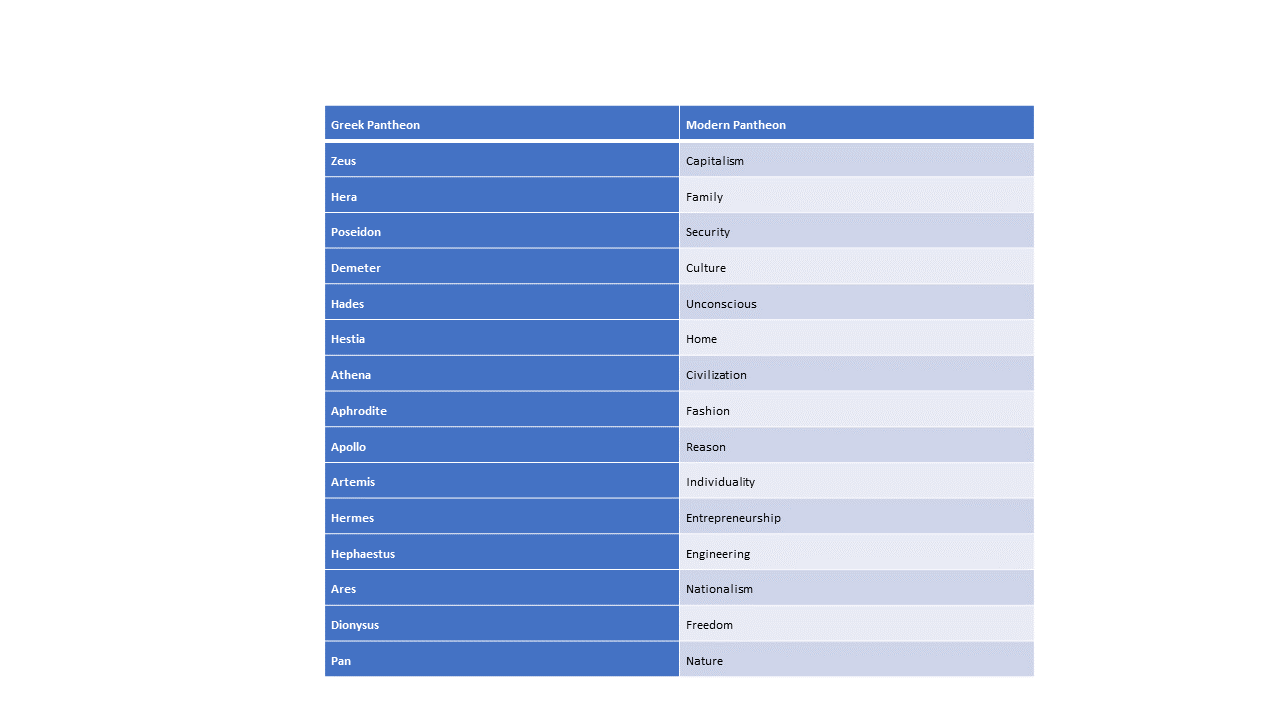
First, a pantheon and the gods within it are attempts to give definition to the human psyche. They are conjectures about a fluid reality that we can never know finally and for certain because we ourselves live within it and it lives and grows within us. To be sure, each of the gods is a vivid character, exhibiting a distinctive personality and starring in striking myths. Nevertheless, the gods are blurrier than they seem initially. They often appear together—Hephaestus is married to Aphrodite, who carries on a secret affair with Ares. Or are related: Zeus, Hera, and Poseidon are siblings. Or share attributes: the lyre and the caduceus are associated with both Hermes and Apollo. It’s easy to glimpse the psychological reality behind these metaphors. For example, Hermes, the god of inspiration, and Apollo, the god of rules and structure, represent the instincts active in music and the other arts. These instincts differ from one another yet are inextricably bound together.
A pantheon is similarly blurry, a fiction rather than a definite theological idea. A pantheon expresses the wholeness or integrity of the world overseen by a seemingly coherent society of gods. The Greeks thought of a pantheon as a dozen gods dwelling on Mount Olympus mainly because a dozen is a round number suggestive of completion. However, the gods which were included in the pantheon changed—is Hades, god of the underworld, really an Olympian? Sometimes gods like Hestia, Dionysus, and Pan belong to the pantheon and sometimes not. (Hence my pantheon features 15 gods.) More importantly, the ancient Greeks and Romans had hundreds, probably thousands of gods. For instance, the Romans had dozens of gods presiding over the various aspects of agriculture (plowing, sowing, harvesting etc.), not just Ceres, who was in the Roman pantheon.
The pantheons and gods of other peoples around the world overlap as well as differ. We all share the human soul, but we slice it up in different ways when we imagine the gods. And differences in culture and ways of life play a role, too, leading us to emphasize express particular instincts in different ways.
So I have chosen 15 abstractions/instincts for my modern pantheon, but this is simply a conjecture. I could have chosen other ones. I don’t present this as a canonical list of the most important human instincts for the modern world. Use the list to stimulate your own thinking.
I used the gods of the Greek pantheon for inspiration, but there isn’t a precise, one-to-one correspondence. I’m not sure an ancient Greek would have understood what we mean by the unconscious. Demeter was very important in the agrarian society of the ancient world, but a goddess of agriculture probably doesn’t belong in the pantheon of an industrial society. Hence, I replaced her with “culture.”
It follows that we shouldn’t think of the gods as mere allegories: visual or narrative representations of abstract ideas. The gods are not one-dimensional. They are independent, living personalities. They don’t bend to our will. They can’t be fully known. Like any human instinct, a god can manifest itself in many different ways. Each exhibits characteristic behaviors, but we can’t predict how a god will act in any given circumstance. A god seldom acts alone but always in tension with other gods in ever-changing configurations. The gods can be surprising and creative. They can also thwart our designs, even cause our destruction.
This brings me to my second major point: We must think differently about the ideas that guide modern life if we conceive of them as gods or, if you prefer, instincts. All of the ideas in my modern pantheon are familiar to everyone. We believe we know what they mean in practical terms even if intellectual debates continue around them. For most of us, they are abstract, bloodless concepts. They are not primary factors in our lives so much as the yardsticks with which we measure them. How much freedom do I enjoy? Is the local park enough nature for me? When we reimagine these ideas as gods, they become less certain, less well defined but also more multifaceted and generative. More possibilities open. They come alive, infusing us with energy in a way that ideas never do.
I’ll take capitalism as my example. I placed capitalism at the head of the modern pantheon just as Zeus was the king of the gods in ancient Greece. I don’t mean that capitalism is the modern form of Zeus, rather that capitalism dominates the modern world just as Zeus, who stood for political power and public life, presided over city-state culture in the Greek imagination.
So what does it mean to treat capitalism as a god and in particular as the chief god?
It means that capitalism doesn’t exist outside of ourselves as an idea, an ideology, or a socioeconomic system. It exists within us as a driving force in our personal lives. We each feel an urge to make money. We try to maximize the value we get from what we sell, even if all we have to sell is our time. Whenever possible, we acquire skills and assets we can sell. Simultaneously, we want to minimize the amount we pay for what we buy, and we accept as a matter of course that markets provide virtually all our material needs. We like to save money to build capital. When we have accumulated enough savings, our thoughts turn to investing it to maximize returns. Many people take the risk of starting a business in hopes of greater rewards, and a few succeed so well that their businesses dominate the economy.
These are nearly automatic behaviors. They aren’t our only behaviors, and money isn’t the only thing we value. Nevertheless, these behaviors reflect more than the working out of abstract economic laws (buy low/sell high, supply and demand etc.). We wouldn’t engage in them if we didn’t feel the impulse within us. Although these behaviors look rational from the outside and can even be modeled mathematically, at their core they are irrational, driven by animal spirits. We control our economic lives less than capitalism controls us.
We can’t know what fate capitalism intends for us. In retrospect, we can tell clear stories—the stock market has risen an average of 8% a year for at least 100 years, Apple has reached a market cap of $3 trillion. But in the moment, the path to the future twists sharply. It took 20 years for the stock market to regain the high it reached in 1929. Apple nearly declared bankruptcy in 1997. In other words, many people lose everything on the way to capitalism’s triumphs. The opposite is also true. In the early 1970s, FedEx owed $24,000 for jet fuel but had only $5,000 on hand. The company’s founder gambled the money in Las Vegas and won enough to pay the fuel bill. Today FedEx generates over $90 billion in sales. Elon Musk started Tesla during a period when the world was awash in capital and interest rates were abnormally low. Burning through capital, Tesla couldn’t have lasted long enough to get established if interest rates were at normal levels. Thus, business is highly contingent, a point that any reader of the Iliad will appreciate, where events thwart the intentions of mortals and gods alike. Only Zeus knows where everything is headed—a secret he keeps with an enigmatic smile—just as only capitalism knows where economic society is headed.
We’re fooling ourselves if we think we know what capitalism is and what it requires. We must respect it as a living, evolving force that largely determines our wellbeing yet ultimately lies beyond our comprehension. Many Greek myths tell of brutal punishments meted out to mortals who disrespect the gods…deliberately, through negligence, through presumption, or by committing some other outrage. The gods don’t necessarily punish the individual alone but could also punish the family or even the state. What greater presumption than the Marxist belief that the future of the economy and society will follow a predictable course, ending with the death of capitalism? Countries that tried to implement Marxist ideas suffered poverty, repression, and mass death. We suffer if we ignore the fundamentals of capitalism, such as free markets.
But we also suffer if we insist on them too much. Programmatic approaches to the economy offend the capitalism god, too: keeping interest rates high or low regardless of circumstances, cutting regulations, lowering taxes, allowing mergers, reducing public debt… In the past, capitalism has punished us for these supposedly pro-business moves through recessions and depressions, financial crashes, man-made disasters, fascism, and other catastrophes. We disrespect the god when we assume today’s form or the form that advantages me is the only possible form of capitalism. Just as the Greek gods appeared in the shape of mortals, animals, plants, and minerals, capitalism took different forms in the past, exhibits many forms today, and will create new forms for itself in the future.
Thus it is with all the gods in the modern pantheon. They are fluid and manifold, unpredictable but not random. We must approach them with humility rather than certainty, devotion rather than proprietorship. All of the gods together determine our fate, but our limited minds can’t follow out their complex interactions to foresee where we will end up. In general, the gods check each other, maintaining a dynamic equilibrium of ever-changing configurations, which nevertheless tend toward balance, which delivers great benefits. The most prosperous era in Western history occurred during the 35 years after World War II, when the interests of the three main pillars of the economy (business, consumers, and government) were balanced. But not even capitalism is all-powerful. We can moderate the pathological behaviors of modern life and achieve unprecedented wellbeing by thinking of our values collectively rather than individually and honoring all of them with due respect.
Capitalism as part of our extended cognition - interesting! Except I'm pretty sure the Hellenes did have an idea or two about the unconscious back then 🤓
Well said.